
We hear the phrase “evidence-based” everywhere in healthcare. A treatment is described as evidence-based. A…
MVA Consultations
AAATCMD’s MVA Advocacy: A Timeline of Engagement, Evidence and Action
In 2024, the AAATCMD was invited by the Alberta Government Treasury Branch to consult on changes to the treatment of MVA (motor vehicle patients). Alberta’s automobile insurance system is undergoing a major transformation, with the province preparing to implement a new care-focused model for people injured in motor vehicle accidents. For Alberta’s acupuncture profession, these changes raise important questions about patient access, provider choice, evidence-informed care, and the role of regulated acupuncturists in assessing and treating MVA-related injuries.
The Alberta Association of Acupuncturists and Traditional Chinese Medical Doctors (AAATCMD) has been actively engaged in this process since the Government of Alberta first approached the Association in late 2024. What followed has been nearly two years of consultation, research review, meetings, formal submissions, and direct advocacy.
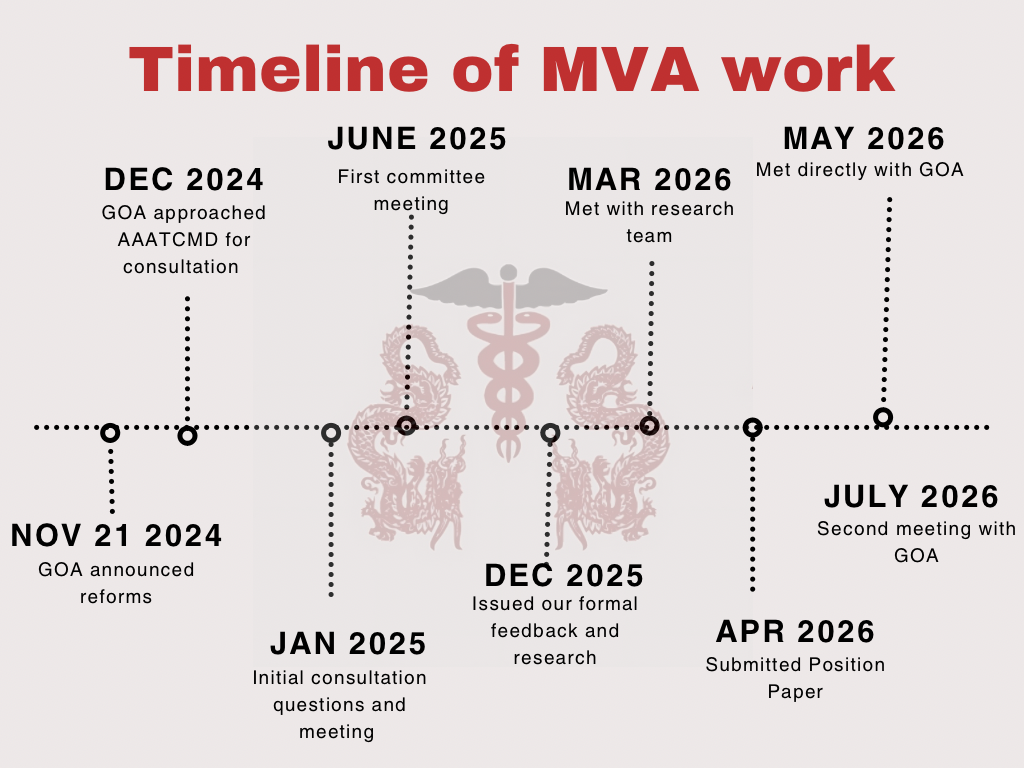
The timeline above provides a snapshot of that work. Here is the story behind it.
November 21, 2024 — Alberta Announces Automobile Insurance Reforms
On November 21, 2024, the Government of Alberta announced significant reforms to Alberta’s automobile insurance system.
For AAATCMD, the announcement immediately raised an important question: What role would regulated acupuncturists and acupuncture treatment have within the new approach to caring for Albertans injured in motor vehicle accidents?
Acupuncturists already treat patients experiencing many of the symptoms and musculoskeletal complaints that can occur following motor vehicle collisions. Changes to the insurance system therefore had the potential to directly affect both patients seeking acupuncture and the regulated professionals providing that care.
November 2024 — Government Approaches AAATCMD for Consultation
Shortly after the reforms were announced, the Government of Alberta approached AAATCMD for consultation. This provided an important opportunity for the profession to contribute directly to the discussion.
From the beginning, AAATCMD’s interest extended beyond simply asking whether acupuncture would be reimbursed as a treatment. The Association also wanted decision-makers to understand the education, assessment, treatment, monitoring and referral competencies of regulated acupuncturists.
That distinction remains important.
Acupuncture is a therapeutic intervention. An acupuncturist is a regulated healthcare professional who assesses patients, develops treatment strategies, monitors response to care, identifies contraindications and recognizes circumstances requiring referral to another healthcare provider.
January 2025 — Initial Consultation and Questions
In January 2025, AAATCMD participated in its initial consultation meeting and began asking detailed questions about the proposed MVA system. This marked the beginning of a more sustained advocacy process. The Association sought greater clarity about how the new model would determine:
- which treatments would be included;
- which healthcare providers could participate;
- how patients would enter and move through care pathways;
- what evidence would be used to develop recommendations; and
- how the competencies of regulated healthcare professions would be evaluated.
For AAATCMD, these were not simply professional-interest questions. They were also questions about how Albertans would access care and whether patients would continue to have meaningful choices among qualified regulated providers.
June 2025 — First Committee Meeting
By June 2025, AAATCMD’s work had progressed to its first committee meeting dedicated to the MVA issue. The Association began examining the research and policy assumptions underlying the proposed approach in greater depth. Particular attention was given to the evidence being used to evaluate acupuncture and musculoskeletal care. It raised a broader methodological issue: Who should be involved in interpreting evidence about a regulated healthcare profession?
AAATCMD’s position has been that rigorous research methodology is essential, but so is relevant clinical expertise. Appropriate subject-matter expertise can help decision-makers understand treatment dosage, clinical application, practitioner competencies, treatment protocols and the practical significance of research findings.
December 2025 — AAATCMD Provides Formal Feedback and Research
Following months of review and discussion, AAATCMD issued formal feedback and supporting research in December 2025. The Association emphasized the vast body of quality research surrounding acupuncture for not only MVA recovery, but also for the associated symptoms such as mental health and sleep disturbances, the importance of considering acupuncturists as healthcare professionals—not merely evaluating acupuncture as an isolated treatment technique, and the importance of patient preference & choice.
March 2026 — Meeting With the Research Team
In March 2026, AAATCMD met directly with the research team. This provided an opportunity to discuss the evidence and methodology more directly. AAATCMD advocated for consideration of more recent research and systematic reviews, particularly where newer evidence could materially change conclusions about acupuncture for musculoskeletal conditions. The Association also continued to emphasize the value of including acupuncture-specific expertise when interpreting this literature, as well as the importance of the patient experience & choice of provider.
April 2026 — AAATCMD Submits a Formal Position Paper
In April 2026, AAATCMD consolidated its concerns and recommendations into a formal position paper. The submission moved the discussion beyond the narrow question of whether acupuncture should appear on a list of treatments. Instead, it addressed broader questions about evidence, professional competency, patient access and the design of MVA care pathways.
AAATCMD is of the position that decisions affecting acupuncture should reflect contemporary evidence and appropriate professional expertise. AAATCMD also emphasized that regulated acupuncturists possess assessment and triage competencies relevant to musculoskeletal patients.
May 2026 — Direct Meeting With the Government of Alberta
In May 2026, AAATCMD met directly with representatives of the Government of Alberta (GOA). This allowed the Association to bring its concerns about evidence, patient access and professional competency directly to decision-makers. AAATCMD emphasized that Alberta has an opportunity to build a system that is both evidence-informed and patient-centered.
The GOA assured the AAATCMD that acupuncture will remain an option for Albertans and expressed confidence in the independent researchers they hired to complete the Rapid Review.
July 2026 — Second Meeting With the Government of Alberta
A second meeting with the Government of Alberta took place in July 2026, allowing AAATCMD to continue the discussion and reinforce its recommendations. By this stage, the Association had moved through multiple levels of engagement: initial consultation, committee work, research review, formal feedback, discussion with researchers, submission of a position paper and direct meetings with government.
The continued engagement reflects the importance of the issue for both the acupuncture profession and the Albertans who choose acupuncture as part of their healthcare.
Where We Are Now
AAATCMD’s work on MVA reform is ongoing.
The Association continues to advocate around five central principles:
- Current evidence matters. Decisions about future healthcare programs should incorporate research published since older evidence reviews were completed.
- Relevant expertise matters. Acupuncture clinicians and researchers should be meaningfully involved when acupuncture evidence and clinical practice are being evaluated.
- Evidence extends beyond a single research design. High-quality research should be considered alongside clinical expertise, pragmatic evidence, safety, outcomes and patient values.
- Patient choice and access matter. Albertans should have meaningful access to appropriate care from qualified regulated healthcare professionals.
- Professional competency matters. The role of regulated acupuncturists should be evaluated on their actual education, assessment, triage, treatment and referral competencies—not simply on whether acupuncture is listed as a treatment modality.
Why AAATCMD Will Continue This Work
The development of Alberta’s MVA Programs of Care is about much more than the inclusion or exclusion of one profession. It raises a larger question about how Alberta decides what constitutes appropriate, evidence-informed healthcare and who is qualified to provide it.
AAATCMD supports rigorous evaluation of acupuncture. At the same time, rigorous evaluation requires contemporary evidence, appropriate clinical expertise and fair consideration of the competencies of the regulated professionals providing that care.
As Alberta moves toward its new MVA care model, AAATCMD will continue advocating for an approach that is evidence-informed, transparent, equitable and centered on the needs of injured Albertans.
The Association will also continue working with government, researchers, regulators, healthcare professionals and other stakeholders to ensure that the perspective of Alberta’s acupuncture profession is represented as these important decisions are made. We are grateful to the GOA for including our association in the healthcare consultation committee and are proud to represent our profession to key policy-makers.

Related Posts
