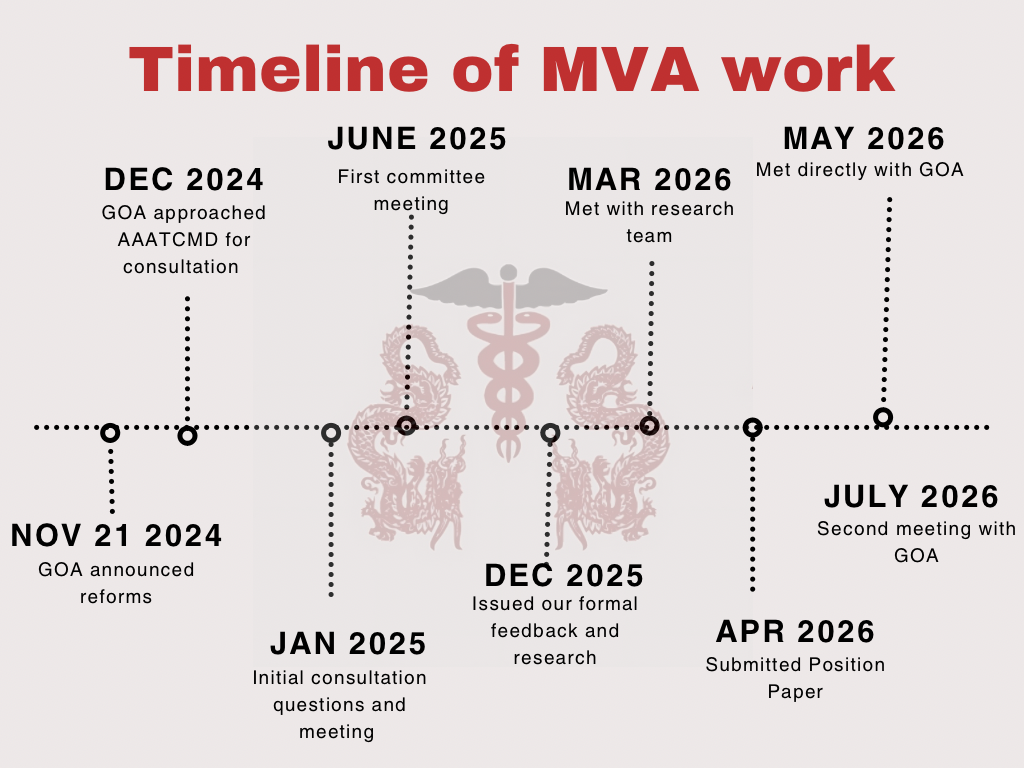
AAATCMD’s MVA Advocacy: A Timeline of Engagement, Evidence and Action In 2024, the AAATCMD was…

Position Paper: Acupuncture for MVA Treatment
AAATCMD Position Paper (April 2026)
Acupuncture as a First-Line Treatment for Motor Vehicle Accident (MVA)–Related Musculoskeletal Injury
A Structured Synopsis with Clinical, Mechanistic, and Policy Argumentation
Abstract
Motor vehicle accidents result in high prevalence of acute soft-tissue injury and chronic disability risk.
Acupuncture demonstrates significant short-term pain reduction, functional improvement, and low
adverse event rate, making it a viable first-line treatment. This manuscript presents evidence-based
justification for its integration into early post-MVA recovery pathways.
Introduction
Soft-tissue trauma following MVA’s is a global clinical and socioeconomic burden. Conventional first-line
care typically includes analgesics and delayed mobilization, which may inadvertently increase chronic
pain risk. Early, active care interventions are essential for favorable prognosis.
Evidence Review
Meta-analytic data report significant pain reduction (SMD ≈ −0.57) and improved range of motion in
WAD cases following acupuncture. Meta-analysis with trial sequential analysis supports the robustness of
these findings, indicating that the available evidence is sufficient, although recovery timelines (e.g., 4–7
days) are derived from individual trials rather than the sequential analysis itself.
Mechanisms of Action
Acupuncture activates endogenous opioid pathways, downregulates inflammatory cytokines, improves
autonomic tone, and reduces myofascial tension—aligning with early functional recovery goals.
Safety Profile
Acupuncture carries a low complication risk. Minor bruising and soreness are the most common
outcomes, far safer than NSAID-related GI bleeding, renal stress, or opioid dependence risk.
Economic and Systems Impact
Short treatment duration (4–6 sessions typical), reduced imaging utilization, and earlier return to work
support strong cost-efficiency. Public and private insurers benefit from chronic pain prevention.
Clinical Recommendation
Acupuncture should be included at the point of initial MVA care. Best applied within the first 7 days
post‐injury, combined with physiotherapy and graded activity.
Conclusion
Acupuncture offers analgesia, mobility restoration, safety, and cost advantage. These support its
placement as primary—rather than secondary or excluded—intervention for MVA-related injury.
Policy Brief: Acupuncture as First-Line Treatment for Post-MVA Injury
Recommendation:
Acupuncture should be implemented as a first-line treatment for Whiplash-Associated Disorder,
post-MVA musculoskeletal injury, and Concussion/Traumatic Brain Injury (TBI)
Key Justifications:
• Evidence-based pain reduction and early ROM restoration
• Acupuncture interventions are associated with faster recovery windows, with MSAT supporting the
robustness of these findings
• Minimal adverse event profile
• Lower cost-of-care and reduced imaging/medication reliance
• Supports physiotherapy participation and rehabilitation progression
• Reduces progression to chronic pain and disability
Implementation Steps:
1. Initiate acupuncture within 1–7 days post-accident.
2. Integrate with graded exercise therapy and physiotherapy.
3. Limit opioid and NSAID use to secondary or declining effect.
4. Track outcomes: pain, ROM, return-to-work metrics.
Current Status of MVA Treatment with Acupuncture among AAATCMD Members
Assessment and treatment of MVA have long been a practice of ASA/AAATCMD members since 2000.
Over 20 years of development, assessment and treatment of MVA is part of standard practice within the
acupuncture profession in Alberta, from training, examination, certification, and registration. The
following are key evidence:
• Assessment and treatment is part of curriculum in TCM schools in Alberta, such as McEwan, CITCM
,and ACTCM
• Assessment and treatment is part of registration and examination in CAA
• Assessment and treatment is part of practice among members of AAATCMD
AAATCMD Member Survey on MVA Treatments
AAATCMD Members reported in a recent survey that:
– Nearly 40% of our members regularly or frequently treat MVA patients
– The majority of acupuncturists are comfortable in their ability to perform physical and orthopedic
assessments of MVA patients
– 60% report receiving referrals for acupuncture for MVA patients from both inside or outside of
their clinic.
– An added 22% also report receiving referrals after other treatments have failed
Summary Information of Acupuncture for MVA
Acupuncture can be helpful after a motor vehicle accident, especially for the kinds of problems that are
most common after MVA: whiplash-associated disorder, neck pain, back pain, muscle spasm, stiffness,
concussion/TBI, and reduced range of motion. The strongest MVA-specific evidence is for
whiplash-associated disorder (WAD) rather than “all MVA injuries” as a whole.
A 2024 systematic review and meta-analysis of acupuncture for whiplash included 8 randomized trials
with 525 patients. It found statistically significant improvement in pain and cervical extension range of
motion. The authors concluded that acupuncture “may have clinical value” for WAD, while also noting
that more high-quality trials are still needed. That means the evidence is promising, but not perfect.
For post-MVA symptoms that overlap with broader musculoskeletal pain, the evidence base is also
supportive. A 2024 systematic review of chronic neck pain found that acupuncture may provide pain
relief lasting at least 3 months, improve function, and had a good safety profile; reported adverse events
were generally mild and temporary.
For low back pain, which is also common after collisions, major guidelines support acupuncture as a
non-drug option. The American College of Physicians recommends acupuncture among initial non-drug
treatments for acute/subacute low back pain and also as an initial option for chronic low back pain. The
WHO 2023 low back pain guideline likewise addresses nonsurgical community-based management and
supports evidence-based nonpharmacologic care for chronic primary low back pain.
More recent trial evidence also supports benefit for persistent back pain: a 2025 NIH-funded randomized
study in older adults with chronic low back pain found that acupuncture led to greater improvements in
pain-related disability, pain intensity, and physical function than usual care alone, with very little in the
way of adverse effects reported. While this was not specifically an MVA trial, it strengthens the case for
acupuncture when an accident leads to ongoing musculoskeletal pain.
On safety, acupuncture is generally considered low risk when performed by a properly trained practitioner
using sterile technique. A 2024 safety review reported that serious adverse events are rare, estimated at
about 0.04–0.08 per 10,000 treatments. Mild effects such as temporary soreness, bruising, light bleeding,
or dizziness are much more common than serious complications.
So, the balanced conclusion is this: acupuncture has the best direct evidence for whiplash-related pain and
neck stiffness after MVA, and supportive broader evidence for chronic neck and back pain, function, and
mobility. It is best viewed as part of a multimodal recovery plan, often alongside exercise rehab, manual
therapy, and medical assessment when red flags are present.
Evidence Summary: Acupuncture for Motor Vehicle Accident (MVA)–Related Conditions
Study Type Key Research Findings
Practical Clinical
Takeaway
Whiplash-Associated
Disorder (WAD)
Systematic Review
& Meta-analysis
(2024, 8 RCTs,
n≈525)
Acupuncture significantly
improved pain intensity and
cervical range of motion,
especially extension. Evidence
suggests meaningful clinical
benefit for WAD symptoms.
Acupuncture can be used as
part of early or subacute
treatment for neck pain,
stiffness, and limited
mobility following whiplash
injuries.
Neck Pain (Acute or
Chronic)
Systematic Review
of RCTs (2024)
Acupuncture demonstrated
moderate evidence for pain
reduction and functional
improvement, with benefits
lasting up to 3 months
post-treatment.
Appropriate for persistent
neck pain after MVA,
particularly when
conservative care is
recommended.
Low Back Pain
(Acute/Subacute)
Clinical Practice
Guideline –
American College of
Physicians (ACP)
ACP recommends
non-pharmacological therapies,
including acupuncture, as
first-line treatment for acute and
subacute low back pain.
Acupuncture is recommended
as a safe, non-drug therapy
for back pain following
trauma such as MVA.
Chronic Low Back
Pain
Randomized
Controlled Trials
and Meta-analyses
Evidence shows acupuncture
improves pain intensity,
disability scores, and functional
outcomes compared with usual
care or sham interventions.
Useful for ongoing pain
after MVA when symptoms
persist beyond the acute
stage.
Musculoskeletal
Pain (General
Trauma-Related)
Systematic Reviews
of Acupuncture
Analgesia
Acupuncture stimulates
endogenous analgesic mechanisms
(endorphins, serotonin,
norepinephrine) and reduces
inflammatory mediators.
Supports acupuncture as part
of multimodal pain
management for soft-tissue
injuries after collision.
Post-Traumatic
Headache /
Cervicogenic
Headache
RCTs and
Systematic Reviews
Acupuncture significantly reduced
headache frequency and
intensity compared with
medication alone in several
studies.
Effective adjunct therapy for
post-whiplash headaches
and neck-related head pain.
Safety Profile
Large Safety
Reviews &
Observational
Studies
Serious adverse events extremely
rare (~0.04–0.08 per 10,000
treatments). Most adverse events
are mild (temporary soreness,
bruising).
Demonstrates high safety
profile when performed by
regulated practitioners.
Key Clinical Message for MVA Cases
Research evidence supports acupuncture as a safe, evidence-informed treatment for several conditions
commonly occurring after motor vehicle accidents, particularly whiplash-related neck pain,
musculoskeletal injury, headaches, and low back pain. Clinical guidelines recommend acupuncture as
a non-pharmacologic therapy that may reduce pain, improve function, and support rehabilitation when
integrated with conventional care. Many patients report that traditional Chinese acupuncture improved
their stress and mood, while practitioners frequently refer complex or poorly responding MVA cases to
our members. Traditional acupuncture can play a large role in the healing of MVA patients.
References
1. Lee S-H, Park S-Y, Heo I, Hwang E-H, Shin B-C, Hwang M-S.. Efficacy of acupuncture for whiplash injury: a
systematic review and meta-analysis. Medicine (Baltimore). 2021;100(49):e27767.
doi:10.1097/MD.0000000000027767.
2. Xie CR, Zhang ZY, Tao QF, Luo XD, Fu QX, Gao L, Wang T, Ouyang X, Yan QY, Sun MS, Wang X, Liang FR, Zheng
H, Zhao L. Effectiveness of acupuncture for neck pain: systematic review and meta-analysis with trial sequential
analysis. J Pain Res. 2025;18:6297–6316. doi:10.2147/JPR.S558059.
3. Qaseem A, Wilt TJ, McLean RM, Forciea MA; Clinical Guidelines Committee of the American College of Physicians.
Noninvasive treatments for acute, subacute, and chronic low back pain: a clinical practice guideline. Ann Intern Med.
2017;166(7):514–530. doi:10.7326/M16-2367.
4. Yu H, Wang D, Verville L, Southerst D, Bussières A, Gross DP, Pereira P, Mior S, Tricco AC, Cedraschi C, Brunton G,
Nordin M, Shearer HM, Wong JJ, Connell G, Myrtos D, da Silva-Oolup S, Young JJ, Funabashi M, Romanelli A, Lee
JGB, Stuber K, Guist B, Muñoz Laguna J, Hofstetter L, Murnaghan K, Hincapié CA, Cancelliere C. Systematic
Review to Inform a World Health Organization (WHO) Clinical Practice Guideline: Benefits and Harms of Needling
Therapies for Chronic Primary Low Back Pain in Adults. J Occup Rehabil. 2023 Dec;33(4):661-672. doi:
10.1007/s10926-023-10125-3. Epub 2023 Nov 22. PMID: 37991648; PMCID: PMC10684627.
5. Vickers AJ, Cronin AM, Maschino AC, Lewith G, MacPherson H, Foster NE, Sherman KJ, Witt CM, Linde K;
Acupuncture Trialists’ Collaboration. Acupuncture for chronic pain: individual patient data meta-analysis. Arch Intern
Med. 2012;172(19):1444–1453. doi:10.1001/archinternmed.2012.3654.
6. White A, Hayhoe S, Hart A, Ernst E. Adverse events following acupuncture: prospective survey of 32 000
consultations with doctors and physiotherapists. BMJ. 2001;323:485–486.
7. White A. A cumulative review of the range and incidence of significant adverse events associated with acupuncture.
Acupunct Med. 2004;22(3):122–133.
8. Xie CR, Zhang ZY, Tao QF, Luo XD, Fu QX, Gao L, Wang T, Ouyang X, Yan QY, Sun MS, Wang X, Liang FR, Zheng
H, Zhao L. Effectiveness of Acupuncture for Neck Pain: Systematic Review and Meta‐analysis with Trial Sequential
Analysis. J Pain Res. 2025 Nov 25;18:6297-6316. doi: 10.2147/JPR.S558059. PMID: 41322280; PMCID:
PMC12664314.
9. Rizzo RR, Cashin AG, Wand BM, Ferraro MC, Sharma S, Lee H, O’Hagan E, Maher CG, Furlan AD, van Tulder MW,
McAuley JH. Non-pharmacological and non-surgical treatments for low back pain in adults: an overview of Cochrane
reviews. Cochrane Database Syst Rev. 2025 Mar 27;3(3):CD014691. doi: 10.1002/14651858.CD014691.pub2. PMID:
40139265; PMCID: PMC11945228.
10. He J, Lai P, Chen X, Liu J, Wang Z, Jia C, Liu Y, Cheng S. Efficacy and safety of the thumbtack needle for neck pain: a
systematic review and meta-analysis. Front Pain Res (Lausanne). 2026 Jan 12;6:1687334. doi:
10.3389/fpain.2025.1687334. PMID: 41601709; PMCID: PMC12832657.
11. Lee S-H, Park S-Y, Heo I, Hwang E-H, Shin B-C, Hwang M-S. Efficacy of acupuncture for whiplash injury: a
systematic review and meta-analysis. BMJ Open. 2024;14(1):e077700.
12. Eucker SA, Glass O, Knisely MR, O’Regan A, Gordee A, Li C, Klasson CL, TumSuden O, Pauley A, Chen HJ, Tupetz
A, Staton CA, Kuchibhatla M, Chow SC; Duke Emergency Department Acupuncture Research team. An Adaptive
Pragmatic Randomized Controlled Trial of Emergency Department Acupuncture for Acute Musculoskeletal Pain
Management. Ann Emerg Med. 2024 Oct;84(4):337-350. doi: 10.1016/j.annemergmed.2024.03.014. Epub 2024 May
22. PMID: 38795078.
13. Kim D, Park KS, Lee JH, Ryu WH, Moon H, Park J, Jeon YH, Seo JY, Moon YJ, Namgoong J, Shin BC, Ha IH.
Intensive Motion Style Acupuncture Treatment (MSAT) Is Effective for Patients with Acute Whiplash Injury: A
Randomized Controlled Trial. J Clin Med. 2020 Jul 2;9(7):2079. doi: 10.3390/jcm9072079. PMID: 32630663; PMCID:
PMC7408694.
14. Stuart S, Armstrong M, Sewell J, Dixon C, Morris R. Acupuncture for whiplash-associated disorder following road
traffic collision: a physiotherapy service evaluation. Acupunct Med. 2020 Aug;38(4):272-278.
doi:10.1177/0964528419899660.
15. Moon TW, Posadzki P, Choi TY, et al. Acupuncture for treating whiplash associated disorder: a systematic review of
randomised clinical trials. Evid Based Complement Alternat Med. 2014;2014:870271. doi: 10.1155/2014/870271.
16. Hwangbo SY, Kim YJ, Shin DG, An SJ, Choi H, Lee Y, Lee YJ, Kim JY, Ha IH. Effectiveness and Safety of
Progressive Loading-Motion Style Acupuncture Treatment for Acute Low Back Pain after Traffic Accidents: A
Randomized Controlled Trial. Healthcare (Basel). 2023 Nov 10;11(22):2939. doi: 10.3390/healthcare11222939.
17. Park BH, Han JH, Park JH, Min TW, Lee HJ, Lee YJ, Lee SH, Park KS, Ha IH. Effectiveness and safety of
motion-style acupuncture treatment using traction for inpatients with acute low back pain caused by a traffic accident:
A randomized controlled trial. Medicine (Baltimore). 2024 Jun 21;103(25):e38590. doi:
10.1097/MD.0000000000038590.
18. Ho L, Lai CNT, Chen H, Law SW, Yu ECL, Lam FPY, Cheung YC, Wu IX, Wong SYS, Sit RWS. Systematic review of
clinical practice guidelines on acupuncture for chronic musculoskeletal pain. BMC Complement Med Ther. 2025 Sep
1;25(1):322. doi: 10.1186/s12906-025-05070-y. PMID: 40890678; PMCID: PMC12403485.
19. Cassidy JD, Carroll LJ, Côté P, Lemstra M, Berglund A, Nygren A. Effect of eliminating compensation for pain and
suffering on the outcome of insurance claims for whiplash injury. N Engl J Med. 2000 Apr 20;342(16):1179-86. doi:
10.1056/NEJM200004203421606. PMID: 10770984.
20. Sterling M, Valentin S, Vicenzino B, Souvlis T, Connelly LB. Dry needling and exercise for chronic whiplash – a
randomised controlled trial. BMC Musculoskelet Disord. 2009 Dec 18;10:160. doi: 10.1186/1471-2474-10-160. PMID:
20021675; PMCID: PMC2805606.
21. Sterling M, Vicenzino B, Souvlis T, Connelly LB. Dry-needling and exercise for chronic whiplash-associated disorders:
a randomized single-blind placebo-controlled trial. Pain. 2015 Apr;156(4):635-643. doi:
10.1097/01.j.pain.0000460359.40116.c1. PMID: 25790454
22. Djaali W, Mihardja H, Viventius Y, Teja Y, Bunawan HL, Setiawan M, Yunita L. The Role of Acupuncture in
Interventional Pain Management. Med Acupunct. 2021 Oct 1;33(5):329-334. doi: 10.1089/acu.2021.0004. Epub 2021
Oct 18. PMID: 35003500; PMCID: PMC8729902.
23. Cheng ZJ, Zhang SP, Gu YJ, Chen ZY, Xie FF, Guan C, Fang M, Yao F. Effectiveness of Tuina Therapy Combined
With Yijinjing Exercise in the Treatment of Nonspecific Chronic Neck Pain: A Randomized Clinical Trial. JAMA
Netw Open. 2022 Dec 1;5(12):e2246538. doi: 10.1001/jamanetworkopen.2022.46538. PMID: 36512354; PMCID:
PMC9856335.
24. Kim S, Lee SH, Kim MR, Kim EJ, Hwang DS, Lee J, Shin JS, Ha IH, Lee YJ. Is cupping therapy effective in patients
with neck pain? A systematic review and meta-analysis. BMJ Open. 2018 Nov 5;8(11):e021070. doi:
10.1136/bmjopen-2017-021070. PMID: 30397006; PMCID: PMC6231582.
25. Cefalì A, Santini D, Lopez G, Maselli F, Rossettini G, Crestani M, Lullo G, Young I, Dunning J, de Abreu RM,
Mourad F. Effects of Breathing Exercises on Neck Pain Management: A Systematic Review with Meta-Analysis. J Clin
Med. 2025 Jan 22;14(3):709. doi: 10.3390/jcm14030709. PMID: 39941380; PMCID: PMC11818914.
26. Graham N, Gross AR, Carlesso LC, Santaguida PL, Macdermid JC, Walton D, Ho E; ICON. An ICON Overview on
Physical Modalities for Neck Pain and Associated Disorders. Open Orthop J. 2013 Sep 20;7:440-60. doi:
10.2174/1874325001307010440. PMID: 24155804; PMCID: PMC3802124.
27. Stuart S, Armstrong M, Sewell J, Dixon C, Morris R. Acupuncture for whiplash-associated disorder following road
traffic collision: a physiotherapy service evaluation. Acupunct Med. 2020 Aug;38(4):272-278. doi:
10.1177/0964528419899660. Epub 2020 Feb 6. PMID: 32026700.
28. Trinh K, Graham N, Irnich D, Cameron ID, Forget M. Acupuncture for neck disorders. Cochrane Database Syst Rev.
2016 May 4;(5):CD004870. doi: 10.1002/14651858.CD004870.pub4. Update in: Cochrane Database Syst Rev. 2016
Nov 17;11:CD004870. doi: 10.1002/14651858.CD004870.pub5. PMID: 27145001.
29. Kim N, Shin BC, Shin JS, Lee J, Lee YJ, Kim MR, Hwang EH, Jung CY, Ruan D, Ha IH. Characteristics and status of
Korean medicine use in whiplash-associated disorder patients. BMC Complement Altern Med. 2018 Apr 6;18(1):124.
doi: 10.1186/s12906-018-2188-7. PMID: 29625626; PMCID: PMC5889578.
30. Chen Y, Zhao Y, Xue X, Li H, Wu X, Zhang Q, Zheng X, Wang T. Statistical analysis of 4 types of neck whiplash
injuries based on classical meridian theory. Acupunct Electrother Res. 2015;40(1):35-52. doi:
10.3727/036012915×14279074629660. PMID: 25980049.
31. Kim Y, Hong Y, Lee S, Kim TH, Nam D, Lee S. Clinical outcomes and psychosomatic correlates of integrative
inpatient care based on Traditional Korean Medicine for acute neck and low back pain following traffic accidents: a
retrospective cohort study. Front Med (Lausanne). 2025 Nov 13;12:1684034. doi: 10.3389/fmed.2025.1684034. PMID:
41322216; PMCID: PMC12657461.
32. Eslamian F, Jahanjoo F, Dolatkhah N, Pishgahi A, Pirani A. Relative Effectiveness of Electroacupuncture and
Biofeedback in the Treatment of Neck and Upper Back Myofascial Pain: A Randomized Clinical Trial. Arch Phys Med
Rehabil. 2020 May;101(5):770-780. doi: 10.1016/j.apmr.2019.12.009. Epub 2020 Jan 16. PMID: 31954696.
33. Seo SY, Lee KB, Shin JS, Lee J, Kim MR, Ha IH, Ko Y, Lee YJ. Effectiveness of Acupuncture and Electroacupuncture
for Chronic Neck Pain: A Systematic Review and Meta-Analysis. Am J Chin Med. 2017;45(8):1573-1595. doi:
10.1142/S0192415X17500859. Epub 2017 Nov 9. PMID: 29121797.
34. Chou R, Wagner J, Ahmed AY, Blazina I, Brodt E, Buckley DI, Cheney TP, Choo E, Dana T, Gordon D, Khandelwal S,
Kantner S, McDonagh MS, Sedgley C, Skelly AC. Treatments for Acute Pain: A Systematic Review [Internet].
Rockville (MD): Agency for Healthcare Research and Quality (US); 2020 Dec. Report No.: 20(21)-EHC006. PMID:
33411426.
35. CAA Examination Committee. November 2025. Interview Survey of TCM schools and AAATCMD members,
November 2025.
36. Wallace SS, Barak G, Truong G, Parker MW. Hierarchy of Evidence Within the Medical Literature. Hosp Pediatr. 2022
Aug 1;12(8):745-750. doi: 10.1542/hpeds.2022-006690. PMID: 35909178.
37. Vatkar A, Kale S, Shyam A, Srivastava S. Understanding the Levels of Evidence in Medical Research. J Orthop Case
Rep. 2025 May;15(5):6-9. doi: 10.13107/jocr.2025.v15.i05.5534. PMID: 40351623; PMCID: PMC12064251.
38. Chen B, Liu D, Li T, Zheng L, Lan L, Yang N, Huang Y. Research Hotspots and Trends on Acupuncture for
Anti-Inflammation: A Bibliometric Analysis from 2011 to 2021. J Pain Res. 2023 Apr 7;16:1197-1217. doi:
10.2147/JPR.S398393. PMID: 37056280; PMCID: PMC10089150.
39. Patel M, Urits I, Kaye AD, Viswanath O. The role of acupuncture in the treatment of chronic pain. Best Pract Res Clin
Anaesthesiol. 2020 Sep;34(3):603-616. doi: 10.1016/j.bpa.2020.08.005. Epub 2020 Aug 8. PMID: 33004170.
40. Li P, Zhao J, Wei X, Luo L, Chu Y, Zhang T, Zhu A, Yan J. Acupuncture may play a key role in anti-depression through
various mechanisms in depression. Chin Med. 2024 Oct 4;19(1):135. doi: 10.1186/s13020-024-00990-2. PMID:
39367470; PMCID: PMC11451062.
41. Dowell D, Ragan KR, Jones CM, Baldwin GT, Chou R. CDC Clinical Practice Guideline for Prescribing Opioids for
Pain – United States, 2022. MMWR Recomm Rep. 2022 Nov 4;71(3):1-95. doi: 10.15585/mmwr.rr7103a1. PMID:
36327391; PMCID: PMC9639433.
42. Björsenius V, Löfgren M, Stålnacke BM. One-Year Follow-Up after Multimodal Rehabilitation for Patients with
Whiplash-Associated Disorders. Int J Environ Res Public Health. 2020 Jul 3;17(13):4784. doi:
10.3390/ijerph17134784. PMID: 32635189; PMCID: PMC7369994.
43. Pico M, Matey-Rodríguez C, Domínguez-García A, Yubero N, Santos-Lozano A. Pain Neuroscience Education in
Children and Adolescents with Chronic Pain: A Systematic Review. Children (Basel). 2025 Oct 1;12(10):1317. doi:
10.3390/children12101317. PMID: 41153499; PMCID: PMC12564171.
44. van der Velde G, Yu H, Paulden M, Côté P, Varatharajan S, Shearer HM, Wong JJ, Randhawa K, Southerst D, Mior S,
Sutton D, Jacobs C, Taylor-Vaisey A. Which interventions are cost-effective for the management of
whiplash-associated and neck pain-associated disorders? A systematic review of the health economic literature by the
Ontario Protocol for Traffic Injury Management (OPTIMa) Collaboration. Spine J. 2016 Dec;16(12):1582-1597. doi:
10.1016/j.spinee.2015.08.025. Epub 2015 Nov 26. PMID: 26631759.
45. Kim D, Lee YJ, Park KS, Kim S, Seo JY, Cho HW, Ha IH. The effectiveness and cost-effectiveness of motion style
acupuncture treatment (MSAT) for acute neck pain: A multi-center randomized controlled trial. Medicine (Baltimore).
2020 Oct 30;99(44):e22871. doi: 10.1097/MD.0000000000022871. PMID: 33126334; PMCID: PMC7598807.
46. Willich SN, Reinhold T, Selim D, Jena S, Brinkhaus B, Witt CM. Cost-effectiveness of acupuncture treatment in
patients with chronic neck pain. Pain. 2006 Nov;125(1-2):107-13. doi: 10.1016/j.pain.2006.06.006. Epub 2006 Jul 13.
PMID: 16842918.
47. Tan L, Zeng L, Wang N, Deng M, Chen Y, Ma T, Zhang L, Xu Z. Acupuncture to promote recovery of disorder of
consciousness after traumatic brain injury: a systematic review and meta-analysis. Evidence-Based Complementary and
Alternative Medicine. 2019;2019:5190515. doi: 10.1155/2019/5190515
48. Li G, Wang B, Fan S, Liu S, Shao L, Li C, Fang Y, Li J, Qiu M, Zhang Y, Pan L. The effect of acupuncture combined
with hyperbaric oxygenation compared with hyperbaric oxygenation alone for patients with traumatic brain injury: a
systematic review and meta-analysis. Front Neurol. 2025;16:1538740. doi: 10.3389/fneur.2025.1538740

Related Posts