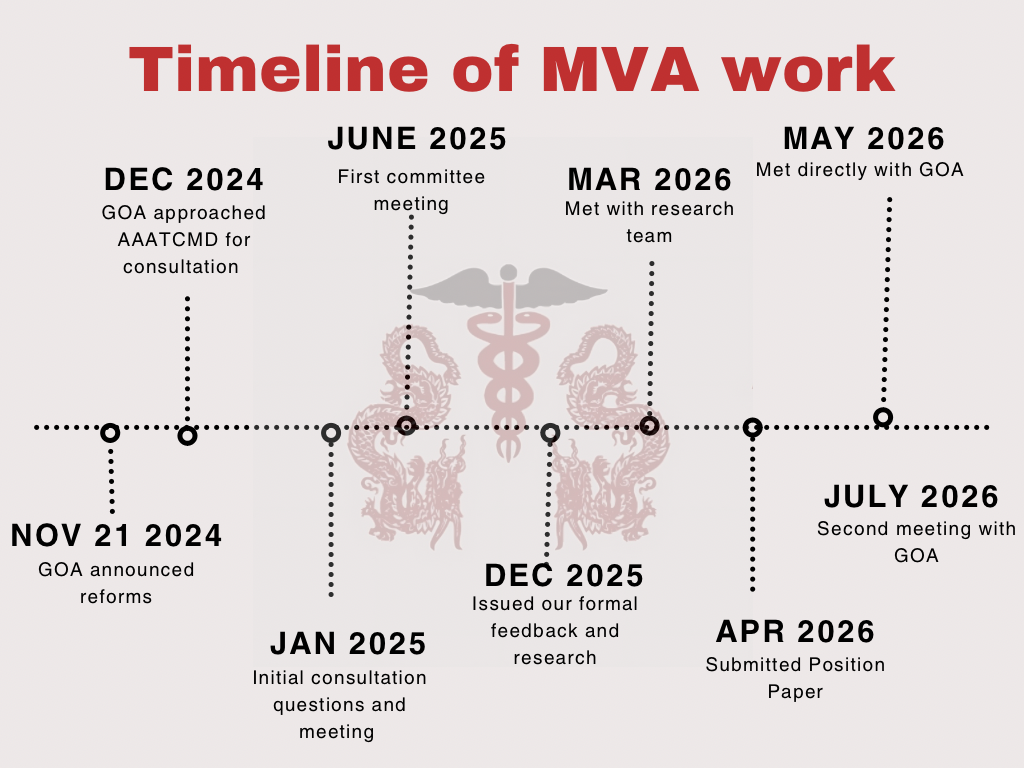
AAATCMD’s MVA Advocacy: A Timeline of Engagement, Evidence and Action In 2024, the AAATCMD was…

Acupuncture & Pain
Acupuncture has long been used for pain management in traditional medicines. The past few decades of research have helped us understand the mechanisms of how acupuncture works for pain. Not only does acupuncture work for pain, but due to the holistic style of Traditional Chinese Medicine, which includes acupuncture, many see improvements in the stress or mood effects often concurrent with pain.
Evidence-Based Acupuncture highlights the following research in their Pain Summaries – check out the great resources they have online.
Research Summary from “Evidence-Based Acupuncture”: Acupuncture & Pain
- National Center for Health Statistics (2006) Health, United States, 2006 [Online] Available from: https://www.cdc.gov/nchs/data/hus/hus06.pdf [Accessed 12 Sept 2017].
- Johannes, C. B., Le, T. K., Zhou, X., Johnston, J. A., & Dworkin, R. H. (2010). The prevalence of chronic pain in United States adults: results of an Internet-based survey. The Journal of Pain: Official Journal of the American Pain Society, 11(11), 1230–1239. http://doi.org/10.1016/j.jpain.2010.07.002
- Breivik H, Collett B, Ventafridda V, Cohen R, Gallacher D. Survey of chronic pain in Europe: prevalence, impact on daily life, and treatment. Eur J Pain. 2006;13:287–333. doi: 10.1016/j.ejpain.2005.06.009.
- National Center for Health Statistics US. “Health, United States, 2016: with chartbook on Long-term trends in health. Hyattsville, MD. 2017.”
- Moseley, G. L., & Flor, H. (2012). Targeting cortical representations in the treatment of chronic pain: a review. Neurorehabilitation and neural repair, 26(6), 646-652. DOI: 10.1177/1545968311433209
- Fried, N. T., Elliott, M. B., & Oshinsky, M. L. (2017). The Role of Adenosine Signaling in Headache: A Review. Brain Sciences, 7(3). http://doi.org/10.3390/brainsci7030030
- National Center for Complementary and Integrative Health (2015) NIH Analysis Shows Americans Are In Pain. [Online] Available from: https://nccih.nih.gov/newspress/08112015 [Accessed 12 Sept 2017]
- The CHP Group (2014) The Cost of Chronic Pain:How Complementary and Alternative Medicine Can Provide Relief. [Online] Available from: http://www.chpgroup.com/wp-content/uploads/2014/12/CHP-WP_CAM-Chronic-Pain_ Sls_12.12.2014.pdf [Accessed 12 Sept 2017].
- Abdel Shaheed, C., Maher, C. G., Williams, K. A., Day, R., & McLachlan, A. J. (2016). Efficacy, Tolerability, and Dose-Dependent Effects of Opioid Analgesics for Low Back Pain: A Systematic Review and Meta-analysis. JAMA Internal Medicine, 176(7), 958–968. http://doi.org/10.1001/jamainternmed.2016.1251
- Krebs EE. Effectiveness of opioid therapy vs. non-opioid medication therapy for chronic back & osteoarthritis pain over 12 months. Inannual meeting, Society for General Internal Medicine, Washington DC 2017. 7
- Rudd RA, Seth P, David F, Scholl L. Increases in Drug and Opioid-Involved Overdose Deaths — United States, 2010–2015. MMWR Morb Mortal Wkly Rep 2016;65:1445–1452. DOI: http://dx.doi.org/10.15585/mmwr.mm655051e1
- Schuchat, A., Houry, D., & Guy, G. P. (2017). New Data on Opioid Use and Prescribing in the United States. Jama, 318(5), 425–426. http://doi.org/10.1001/jama.2017.8913
- Deyo, R. A., Korff, Von, M., & Duhrkoop, D. (2015). Opioids for low back pain. BMJ (Clinical Research Ed.), 350, g6380. http://doi.org/10.1136/bmj. g6380
- Motgahre, V. M., Bajait, C. S., & Turankar, A. (2016). Prescription pattern and adverse drug reaction profile of drugs prescribed with focus on NSAIDs for orthopedic indications at a tertiary care hospital. Skin. http://doi.org/10.18231/2393-9087.2016.0007
- Bally, M., Dendukuri, N., Rich, B., Nadeau, L., Helin-Salmivaara, A., Garbe, E., & Brophy, J. M. (2017). Risk of acute myocardial infarction with NSAIDs in real world use: bayesian meta-analysis of individual patient data. BMJ (Clinical Research Ed.), 357, j1909–13. http://doi.org/10.1136/bmj.j1909
- Cai, S., Garcia Rodriguez, L. A., Masso-Gonzalez, E. L., & Hernandez-Diaz, S. (2009). Uncomplicated peptic ulcer in the UK: trends from 1997 to 2005. Alimentary Pharmacology & Therapeutics, 30(10), 1039–1048. http://doi.org/10.1111/j.1365-2036.2009.04131.x
- Bally, M., Dendukuri, N., Rich, B., Nadeau, L., Helin-Salmivaara, A., Garbe, E., & Brophy, J. M. (2017). Risk of acute myocardial infarction with NSAIDs in real world use: bayesian meta-analysis of individual patient data. BMJ (Clinical Research Ed.), 357, j1909–13. http://doi.org/10.1136/bmj.j1909
- Xiang, A., Cheng, K., Xu, P., & Liu, S. (n.d.). The immediate analgesic effect of acupuncture for pain: a systematic review and meta-analysis.
- Weidenhammer W, Streng A, Linde K, Hoppe A, Melchart D. Acupuncture for chronic pain within the research program of 10 German Health Insurance Funds–basic results from an observational study. Complementary therapies in medicine. 2007;15(4):238-46.
- American Specialty Health Incorporated Health Services Department. (2016). Acupuncture: Does Acupuncture Provided Within a Managed Care Setting Meet Patient Expectations and Quality Outcomes?, 1–12.
- Vickers, A. J., Cronin, A. M., Maschino, A. C., Lewith, G., MacPherson, H., Foster, N. E., et al. (2012). Acupuncture for Chronic Pain. Archives of Internal Medicine, 172(19), 1444. http://doi.org/10.1001/archinternmed.2012.3654 8
- MacPherson, H., Vertosick, E. A., Foster, N. E., Lewith, G., Linde, K., Sherman, K. J., et al. (2016). The persistence of the effects of acupuncture after a course of treatment. Pain, 1–22. http://doi.org/10.1097/j.pain.0000000000000747
- Yin, C., Buchheit, T. E., & Park, J. J. (2017). Acupuncture for chronic pain: an update and critical overview. Current Opinion in Anaesthesiology, 1. http://doi.org/10.1097/ACO.0000000000000501
- Longhurst, J., Chee-Yee, S., & Li, P. (2017). Defining Acupuncture’s Place in Western Medicine. Scientia, 1–5.
- Zhang, Z.-J., Wang, X.-M., & McAlonan, G. M. (2012). Neural Acupuncture Unit: A New Concept for Interpreting Effects and Mechanisms of Acupuncture. Evidence-Based Complementary and Alternative Medicine, 2012(3), 1–23. http://doi.org/10.1016/j.brainresbull.2007.08.003
- Harris, R. E., Zubieta, J.-K., Scott, D. J., Napadow, V., Gracely, R. H., & Clauw, D. J. (2009). Traditional Chinese acupuncture and placebo (sham) acupuncture are differentiated by their effects on μ-opioid receptors (MORs). NeuroImage, 47(3), 1077–1085. http://doi.org/10.1016/j. neuroimage.2009.05.083
- Zhao, Z.-Q. (2008). Neural mechanism underlying acupuncture analgesia. Progress in Neurobiology, 85(4), 355–375. http://doi.org/10.1016/j.pneurobio.2008.05.004

Related Posts